Although we have evidence that a chess club was formed in Shrewsbury in 1852 (which subsequently folded), the game does not appear to have taken off in a big way locally until the late 1880's. There was however a huge upsurge in interest in chess in the last few years of the 19th century both in Shropshire, with several new clubs formed, and across the whole country. Two people in particular played a major part in this chess explosion not only in the UK but throughout the western world.
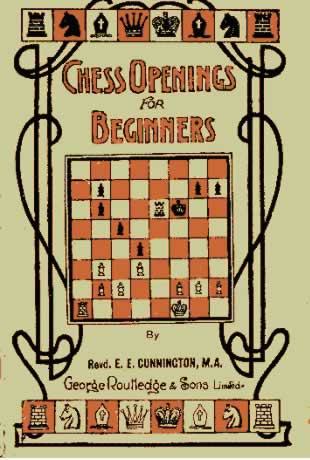
The Reverend E E Cunnington while a member of Bridgnorth Chess Club produced a series of chess books published from 1893 onwards which explained the game in a style that could be widely understood by everyman. This gifted teacher made the game accessible to the people rather than to an intellectual elite. For over fifty years his best selling chess books were an essential first step for every budding chess player on both sides of the Atlantic. Thus the foundations for the modern chess world were well and truly laid in Shropshire!
British chess champion J.H.Blackburne (born Manchester but based in London) toured the country during this same period with his very popular road show of simultaneous, sometimes blindfold, displays which must have inspired so many people to learn more about this fascinating game. Almost every chess club in the country must have hosted such an event - indeed many new clubs were formed in order to do so. While based in Much Wenlock T H Chetwynd (who played many games with Rev.Cunnington and assisted with The British Chess Code p.1894) recalled playing four times in simultaneous games against Blackburne. Clearly Shropshire was a major stopping off point for the legendary British Master who must have met with Cunnington during this time.
Thus the inspiration and genius of the master and the popular works of the author raised the whole chess world to a new level.
***************************************
Extract from The Era of 27 Apr. 1845 (p.12), in which there is a brief note :
"CHESS-- We are informed that the gentlemen of the Kidderminster Chess Club, are willing to play a friendly game with the gentlemen of Shrewsbury and its vicinity."
Extract from Eddowes Journal 14/07/1845
CHESS
MR. C. PHILLIPS, of New Hall, Shrewsbury, will be happy to play any gentleman or gentlemen a Match of from 3 to 5 Games,
by Corresepondence, at 5s. per game to defray postage. July 14,1845.
("an early item re Shropshire chess . this is issued during Royal Agriculture Show week, when their show was at Shrewsbury for the first time" - Alan Brisbourne. 28/11/2016)
-----------------------------------------------------------
Shrewsbury School - Brighton College [B32]
Correspondence match, 1849
This is probably the earliest game known for a Shropshire team. As far as I am aware, it is the first inter-school game to be published in this country. It is very likely that the moves would have been a joint effort from the pupils of each school. In the nineteenth century there were several consultation games between clubs, which would have used this format.- Brian Denman
- Sussex Chess Association archivist.
1.e4 c5 2.Nf3 Nc6 3.d4 cxd4 4.Nxd4 e5 5.Nb3 Nf6 6.Bd3 Be7 7.0-0 0-0 8.c4 d6 9.Nc3 Kh8 10.h3 Be6 11.a3 Ng8 12.Nd5 f5 13.f4 fxe4 14.Bxe4 Nf6 15.Nxe7 Nxe7 16.Bd3 e4 17.Re1 d5 18.cxd5 Bxd5 19.Bc2 Nf5 20.Nc5 Qe7 21.b4 Rad8 22.Bb2 b6 23.Na4 Bc6 24.Qe2 Qe8 25.Nc3 Nd4 26.Qf2 Nh5 27.Bxe4 Rxf4 28.Qe3 Bxe4 29.Nxe4 Nc2 30.Bxg7+ Kxg7 31.Qc3+ Kh6 32.Qxc2 Qg6 33.Re2 Rdf8 34.Rd1 Re8 35.Rd6 Re6 36.Rxe6 Qxe6 37.g4 Qg6 38.Kh2 Rf1 39.Qd2+ Kg7 40.Qd4+ Nf6 41.g5 Kf7 42.gxf6. 1-0
Sources: Illustrated London News of 29.12.1849, 'Chess' of September 2003 and 'Correspondence Chess in Britain and Ireland 1824-1987' - T D Harding - McFarland and Co - Jefferson, North Carolina and London (2011). According to the ILN the game was played 'lately'.
-----------------------------------------------------------
Extract from Shrewsbury Chronicle – Friday
November 7th, 1852
SHREWSBURY CHESS CLUB – We are happy to
find that a society has recently been established in Shrewsbury, under
the presidency of Dr Kennedy, for the practice of this most interesting
game. About 20 gentlemen, including several clergy of the town, have
already become members, and we have no doubt that the number of members
will eventually be sufficient to render it as a permanent institution.
---------------------------------------------------
Extract from Wellington Journal 1st December 1860
Great Chess Match -
A chess-match of considerable interest was played on Friday evening week, at the rooms of the Shropshire Mechanics' and Literary Institution, Dogpole, Shrewsbury.
Mr Lumbley, a blind gentleman from Manchester, who has attained considerable rank as a chess player, undertook to contest six different games at once against six of the best amateurs in Shrewsbury who were willing to take up the challenge. The boards were taken by Dr. Kennedy, Charles Phillips,Esq., W.D.Field,Esq., Mr.S.E.Smith, Mr.J.T.Rawlings, and Mr.Charles Dixon. The play commenced at eight o'clock, and did not terminate till nearly two the following morning, and resulted, after a very interesting struggle, in Dr.Kennedy, Mr.Phillips, and Mr.Smith, winning their respective games, and Mr.Lumbley gaining the remainder.
During the evening Captain Cholmondeley, Mr.F.Sandford, Mr.Foulkes, (surgeon), Mr.Cresswell, and many other admirers of the game were present, though as the boards were already full they did not take part in the contest. Mr. Lumbley is only 23 years of age, and has been totally blind since he was 13. He has, however, a thorough command of the board, and from his powers of combination and extraordinary memory, is a very formidable opponent.
----------------------------------------------------------
The above newspaper cuttings are the earliest references
we have of a chess club in Shropshire. The club still
flourishes in the town today. Coincidently its longest serving current
member, David Everington, lives in the road named after its founder,
although that honour probably owes more to Dr Kennedy's exceptional
services to Shrewsbury
School than to his chess prowess.
We have no later record of the
club which must subsequently have folded. However there was clearly
a major upsurge in chess interest in the area during the 1880's and
1890's when several local chess clubs were active as shown below.
Extracts from the “Chess Player’s
Annual and Club Directory” for 1893-94
Info courtesy of Mike Hughes - Wrexham Chess
Club
The Directory mentions a number of clubs in Shropshire
as follows:-
Bridgnorth Institute Chess Club founded in 1884. Meets daily 9am to 10pm at the institute. “Special” meeting at 6pm Tuesday. There are 31 members and the subscription for
members of the institute is two shillings. The club uses BCA rules.
The President is CJ Cooper and the Secretary FH
Joynson of Albion Terrace. Visitors welcome.
Ellesmere Chess Club. founded in
1888 and meets at the Reading Room. Subscription one shilling. President Brownlow Secretary R.C. Tower.
Ironbridge Chess Club founded in 1888. Meets at
the Wharfage Reading Room.
President JPG Smith. Secretary R. Eaton
Oswestry Chess Club founded 1889. Meets at the Coach
and Dogs Restaurant on Wednesdays at 7.30 pm. The subscription is
two shillings and sixpence.
President JW Thomas. Secretary WR
Minshall, Castle View.
Shrewsbury Chess Club (founded 1890) and meeting at Jones Bros. Restaurant on Mondays and Thursdays at 7.30pm. The subscription is 3s 6d and there are 36 members. The President is Dr. De Woolfson and the Secretary is F.G. Rowland of Wyle Cop.
Wellington Chess Club founded in 1891. Meets at
the Central Hotel on Tuesdays at 7pm. There are 12 members and the
subscription is five shillings.
The President is Rev. HJ Alcock and the Secretary
J. France of Glenelg.
________________________________________
The Chess Player's Annual and Club Directory edited by Mr and Mrs T.B.Rowland and published in Dublin provides a fascinating insight into the game throughout the world. Much of the fourth edition (1890) is devoted to four-handed chess as played at the London Four-Handed Chess Club.
This edition lists two clubs in Herefordshire:-
Hereford Chess Club founded 1888 - City Temperance Hotel: daily, 7 pm. Members 15. Subn. 5s. Pres.Chas.Anthony, B.L.,M.A., Wharton Lodge, near Ross. Sec.W.Collins, High Town.
Kington Chess Club (1888) - The Burton House Hotel: Fri. members 12. Ent. fee 7s 6d. Subn. 5s. Sec.Robt.W.Satchell.
___________________________________________
By the early 20th century there was competition between clubs from
Shrewsbury, Wellington, Ludlow and Hereford. The present league trophy
only dates back to 1946, so there must have been a pre-war league
trophy now lost. Shropshire, later with Herefordshire, also competed
in inter-county competition. Interestingly many of Shropshire's clergymen
were keen players.
|
Dr.B.H.Kennedy
- Founded Shrewsbury Chess Club in 1852
Benjamin
Hall Kennedy (November 6, 1804 - April 6,
1880) was an English scholar. He was born at Summer Hill, near Birmingham,
the eldest son of Rann Kennedy (1772-1851), of a branch of the Ayrshire
family which had settled in Staffordshire. Benjamin was educated at
Birmingham and Shrewsbury schools, and St John's College, Cambridge.
After a brilliant university career he was elected fellow and classical
lecturer of St John's College in 1828. Two years later he became an
assistant master at Harrow, whence he went to Shrewsbury as headmaster
in 1836. He retained this post until 1866, the thirty years being marked
by a long series of successes for his pupils, chiefly in classics.
His broadening of the academic syllabus and addition of recreational
activities to the curriculum led to the school’s academic reputation
being sealed in 1868 with its inclusion as one of the seven ‘great’
schools in the Public Schools Act.
Extract
from Samuel Butler’s autobiographical novel, The
Way of All Flesh.
Here is the scene in which the narrator,
Mr. Overton, meets Ernest’s headmaster at Roxborough School, Dr.
Skinner, who is an ordained clergyman. Mr. Overton plays a game of
chess with him (Roxborough is Shrewsbury School, to which Butler
was sent, and Dr. Skinner is Dr. Kennedy, who was later Bishop of Worcester),
and when it is nearly over, his wife asks “in a silvery voice”:
“What will you take for supper, Dr. Skinner?” He made no
answer for some time, but at last in a tone of almost superhuman solemnity,
he said, first, “Nothing,” and then, “Nothing whatever.”
By and by, however, I had a sense come over me as though I were nearer
the consummation of all things than I had ever yet been. The room seemed
to grow dark as an expression came over Dr. Skinner’s face which
showed that he was about to speak. The expression gathered force, the
room grew darker and darker. “Stay,” he at length added—and
I felt that here at any rate was an end to a suspense which was rapidly
becoming unbearable— “Stay—I may presently take a
glass of cold water—and a small piece of bread and butter.”
As he said the word “butter” his voice sank to a hardly
audible whisper; then there was a sigh as though of relief when the
sentence was concluded, and the universe this time was safe. Another
ten minutes of solemn silence finished the game. The Doctor rose briskly
from his seat and placed himself at the supper table. “Mrs. Skinner,”
he exclaimed jauntily, “what are those mysterious-looking objects
surrounded by potatoes?” “Those are oysters, Dr. Skinner.”
“Give me some, and give Overton some.” And so on until he
had eaten a good plate of oysters, a scallop shell of minced veal nicely
browned, some apple tart, and a hunk of bread and cheese. This was the
small piece of bread and butter.
****************************************
|
 Rev.E.E.Cunnington - 1853 - 1942 Rev.E.E.Cunnington - 1853 - 1942
The Reverend Edward Ernest Cunnington MA was for over fifty years one of the most popular and influential chess authors in the English-speaking world. His lucid style helped introduce and unravel the mysteries of chess to many generations on both sides of the Atlantic and was essential reading both for beginners and the more experienced players alike.
Census information (researched by Dr Trevor G. Hill, Local and Community Historian.) shows that he was born in Devizes, Wiltshire in 1853, the son of Edward Cunnington a Wine Merchant and Mary his wife. By 1871 he was a scholar at a school in Bishop's Hull, Taunton under the tutorship of Christopher Bowsfield(?). In 1881 he is in lodgings at St Johns Hampstead, London with what appears to be a relation (elder brother?) Cecil W Cunnington - medical student. No occupation is shown for Edward - he probably trained as a priest at Oxford or Cambridge.
In 1891 he was living on his own in Enville (41 Four Ashes Lodge) and shown as the curate of Holy Innocents, Tuck Hill (Church of England near Claverley in Shropshire). By now a keen chess player, he was almost certainly a member of Bridgnorth Chess Club (founded in 1884). Another member, T.H.Chetwynd, played many games with him (Hereford Times, August 11 th 1948). It was during his time here in Shropshire that he wrote his early best selling chess books which had such a major influence on the chess world. Incredibly up to this time there were several variants of the rules of the game. Each club would choose which discipline to follow. This must have made competition very confusing. The British Chess Code, written by Cunnington (with assistance of Chetwynd) was intended to unify the rules.
In 1901 Cunnington was living in Llangarren near Ross on Wye, shown as a clergyman. As there was an older clergyman shown in the parish it would appear that Revd Edward Cunnington was still a curate. Although no longer based in Shropshire, his output of best selling chess books continued unabated for several more years.
His books, published in England by George Routledge and Sons Ltd, include :-
How to Play Chess (1893),
How to Play Chess Well! (1893),
The British Chess Code (1894)
– published the same year in the United States, under the auspices of the Manhattan Chess Club, as The American Chess Code
Half-hours with Morphy (1899),
The Modern Chess Primer (1899),
Chess Openings for Beginners (1900)
Chess Lessons for Beginners (1900)
The latter two were published in the United States, as Chess for Beginners, at least until 1944.
Chess Traps and Stratagems (1903),
Selected Chess Endings (1903),
Lessons in Pawn Play (1913).
In addition Rev.Cunnington revised Staunton's The Chess Player's Textbook (1910).
His writings were not confined to chess:-
1914. E. E. Cunnington, The New Covenant, commonly called the New Testament of our Lord and Saviour Jesus Christ: A revision of the version of A.D. 1611. London: G. Routledge & Sons, 1914. Based on the so-called "Western" readings noted in the Greek Nestle text (4th edition).
Rick Kennedy writes :- The books went through many editions and printings, and at least three of them outlasted the author, himself. Rev. Cunnington died in 1942, while Chess Lessons for Beginners went at least to the 22 nd edition in 1947; and Chess Openings for Beginners (1900) saw a 20 th edition in 1951. (The uncertainty in dates is due to the fact that not all of the editions bore a publication or copyright date.) How to Play Chess , revised and rewritten by J. DuMont, was published in 1958.
Timothy Sawyer has brought Chess Lessons for Beginners and Chess Openings for Beginners back to life in 2004 by translating them to the ChessBase format for the computer. Pickard & Son has published them as e-books ("electronic books") and added them to ChessCentral's expanding list of e-book titles, including classics such as Capablanca's Chess Fundamentals and My Chess Career , Reti's Modern Ideas in Chess , and Lasker's Common Sense in Chess ; and game collections like Nizzola's Discart-Bonetti Match, 1863 , Bird's Chess Masterpieces , Graham's Mr. Blackburne's Games at Chess , and Sergeant's Morphy's Games of Chess .
Here is a sample from Chess Lessons for Beginners (but converted to algebraic notation) :-
Queen's Gambit Accepted [D20]
Game 9
[Cunnington, E. E.]
1.d4 d5 2.c4 dxc4 [It is safe enough to take the pawn, but Black should not try to keep it; for consequences of the latter course, see Chess Openings for Beginners in this series.] 3.e3 e5 4.Bxc4 [Much better than 4.Qa4+ and 5.Qxc4, taking two moves to do what the one move does better.] 4...exd4 5.exd4 [An isolated pawn (connected with, or supported by, no other pawn) does not matter in this Opening; it is easily defended, and can generally be exchanged.] 5...Nf6 6.Nc3 Be7 7.Nf3 0-0 8.Be3 c6 [To keep the Knight from advancing to Black's side, and to furnish a support for Black's Knight at d5. 8...Ng4 would do no good; White would withdraw 9.Bd2 and afterwards drive away the Knight.] 9.h3 Nbd7 10.Bb3 Nb6 11.0-0 Nfd5 [Black, seeing that his opponent has more command of the board (that more squares are open to his men) than he, wishes to change off some of the pieces, to gain room. But he would like White to make the exchanges.] 12.a4 [Leaving Black to do the exchanging; as, in this case, White will bring a pawn to support his d-pawn.] 12...a5 [To stop 13.a5, dislodging the Knight.] 13.Ne5 Be6 14.Bc2 f5 [Blocking the diagonal by which the White King's Bishop bears on the h-pawn.] 15.Qe2 f4 [This is not good. The White Bishop is as well at d2 as at e3; and the pawn cannot retreat. Besides, pawns become weaker, and more difficult to defend, the farther they are advanced from home at the beginning of the game. This game is still in an early stage, all the pieces being yet on the board.] 16.Bd2 Qe8 17.Rae1 [This threatens to win a pawn by 18.Nxc6 Qxc6 19.Qxe6+ etc.] 17...Bf7 [Getting the Bishop out of danger; he might have supported it by 17...Nc7 . The actual move blocks the King's Rook.] 18.Qe4 [Threatening 19.Qxh7 mate. If he had done this a move earlier, Black could have answered 17...Bf5, driving off the Queen, and then taking the troublesome King's Bishop.] 18...g6 [If 18...Bg6 White would take it with Knight 19.Nxg6 gaining a pawn. But this forced advance of the protecting pawns weakens Black King's position.] 19.Bxf4 Nxf4 20.Qxf4 [White has won a pawn, and his position is strong, owing to some of Black's pieces (Queen's Rook and Queen's Knight) being out of play. The men, too, round Black's King are huddled together, and in each other's way. We have now reached the crisis of the game. Here we may quote M. Mery's lines, giving the meditations of the Black Bishop on his next move: "Si je prenais, dit-il, la quatrieme case,\En face du carre que le fou, mon rival,\Occupait au debut, a cote du cheval,\Ce poste m'obtiendrait une victoire sure;\Je menace les blancs d'une double blessure:\Labourdonnais n'a pas prevu ce mauvais tour;\S'il veut sauver sa reine, alors je prends sa tour;\Apres, je serai pris, tant mieux ! cela m'arrange,\La tour vaut mieux qu'un fou, nous gagnerons l'echange."] 20...Bc4 [But, alas! his hopes were soon dashed to the ground: "Le general francais avait bien attendu,\Que les noirs tomberaient dans le piege tendu." If 20...Nd5 then 21.Nxd5 . ] 21.Qh6 Bxf1 22.Bxg6 [Here again we quote the poet: "Il sait qu'il va mourir; cette mort, il l'implore\Sage fou qui deja, quoique mourant, peut voir\Le redoutable mat planant sur le roi noir !"] 22...hxg6 [Forced, in the sense that he has no better way to stave off the mate threatened by 23.Qxh7#.] 23.Nxg6 Nc8 [To guard the King's Bishop from attack of the Rook and Knight. If 23...Rf7 then 24.Qh8# . ] 24.Qh8+ Kf7 25.Qh7+ Kf6 26.Nf4 [Threatening 27.Ne4 mate, or 27.Re6+ if Black guards e4.] 26...Bd3 [Of course, White could take this Bishop for nothing; but why linger to do this, when he can mate in three moves?] 27.Re6+ Kg5 28.Qh6+ Kf5 29.g4# [ 29.Re5# would answer the same purpose.] , 1-0
****************************************
|
Extract from Wellington Journal 12/05/1894 courtesy Alan Brisbourne
FORMATION OF A SHROPSHIRE CHESS ASSOCIATION.
A meeting was held on Thursday afternoon at the Shrewsbury Chess Club's Room, for the above purpose. These were present:- Rev.H.J.Alcock, Messrs.C.Groom and Jas.France (representing Wellington),Rev.E.E.Cunnington and Mr.Altringham (Much Wenlock), Mr.F.H.Joynson (Bridgnorth), Mr.Baddeley (Newport), Mr.J.S.Barker (Dawley), and Messrs.G.H.Lock, M.A., W.Stevens, Wright, Hawker, Smith, Rowland, and Turner (of the Shrewsbury Chess Club). Mr Groom was elected chairman. – The following resolutions were carried nem.con. :- Proposed by Mr.Jas France, seconded by Mr.Turner, that the Shropshire Chess Association be now formed. Proposed by Mr.Clement Groom, seconded by Mr.Joynson, that Mr G.H.Lock be president. Proposed by Mr.Turner, seconded by Mr.F.G.Rowland, that the five M.P.s for Shropshire be elected vice-presidents, subject to their sanction being obtained. Proposed by Mr.J.S.Barker, seconded by Mr.J.H.Lock, that Mr C.L.Smith, of 13, Wood Street, Greenfields, Shrewsbury, be honorary secretary and treasurer. Proposed by the Rev.H.J.Alcock, seconded by Mr.Baddeley, that the committee consist of a delegate from each of the chess clubs in the county. Proposed by Mr.Turner, seconded by the Rev.H.J.Alcock, that the subscription for each club be 5s. per annum. Any person wishing to become a member of the association can do so by joining the nearest chess club. The objects of the association are to promote properly organised matches between the various clubs on the same lines as the football matches conducted with so much success by the Shropshire League, and also to play inter-county matches.
*********************************************
|
| A
game from the British Chess Magazine, May 1899, played
in the cable match between British and American universities. The teams
were evidently pretty exclusive – the British being represented
by players from Oxford and Cambridge and the Americans by Yale, Harvard,
Princeton and Columbia.
The match score:
British Universities 3.1/2 - 1.1/2. American Universities
Mr CEC Tattersall 1/2-1/2 Mr KG Falk
Mr AHW George 0 - 1 Mr AS Meyer
Mr L McLean 1 - 0 Mr CSC Arensberg
Mr A P Lacy Hulbert 0 - 1 Mr L A Cook
Mr GEH Ellis 1 - 0 Mr WW Young
Mr HG Softlaw 1 - 0 Mr W Cutchings
Board 4 for the British was Shropshire’s future long-serving county
secretary and three-times individual champion, Arthur Percival
Lacy Hulbert. Here is his game, in which the BCM used notes
from The Field. (I have converted to algebraic – DE)
White: Mr Lacy Hulbert (Oxford)
Black: Mr L A Cook (Yale) Petroff’s Defence
1.e4 e5 2.Nf3 Nf6 3.Ne5 d6 4.Nf3 Ne4 5.d4 d5 (In the late Vienna tournament
not a single Petroff was defended with this variation. 5….Be7
6.Bd3 Nf6 was generally played) 6.Bd3 Bd6 7.Qe2 O-O 8.O-O f5 9.c4 c6
10.Nc3 Kh8 11.cd cd (He could have played 11…Nd5 to avoid White’s
next move but as the continuation which follows is only an exchange
of pawns, it does not matter) 12.Nd5 Bh2+ 13.Kh2 Qd5 14.Re1 Nf6 15.Qe7
Qd1 16.Ng5 Qe7 17.Re7 Nc6 18.Rc7 Nd5 19.Rf7 Rf7 20.Nf7+ Kg8 21.Nd6 Nce7
(21…Nd4 would have been dangerous, because of 22.Bc4 etc) 22.Bd2
b6 23.Re1 Bd7 24.Bc4 Kf8 25.Re5 Nf6 26.f3 Nc6 27.Re3 (The annotator
gives some long variations here, suggesting that White emerges better
after 27.Nf5 Ne5 28.Bb4+) 27….Nd4 28.Bc3 Nc6 29.b4 Ne8 30.Ne8
Re8 31.Re8+ Be8 32.b5 Ne7 33.a4 Bf7 34.Bd3 h5 35.Be5 g6 36.Bc2 Bc4 37.Kg3
Kf7 38.Kh4 Ke6 39.Bb7 Nc8 40.Kg5 Kf7 41.Kf4 Ke6 42.Bd1 Kf6 43.Be5+ Ke6
44.g4 (Throwing away a hard-played game by a mistake. He had to return
the B to b8 and play for the draw) 44….hg 45.fg g5+ 46.Kg5 Ke5
and White resigned a few moves later.
|
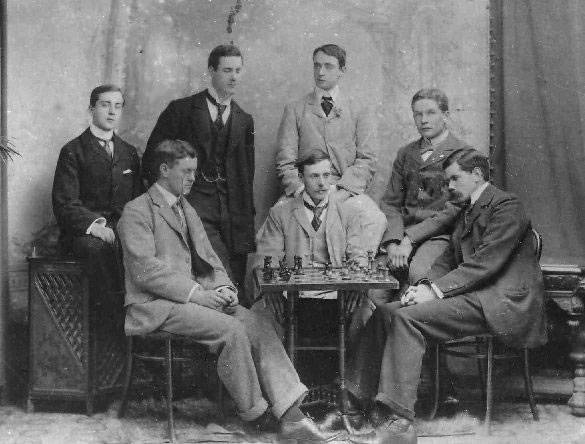 |
| The photograph, kindly
supplied by Lacy-Hulbert’s daughter, Margaret Jones, shows the
Oxford University Chess Team of 1898. The players are: back row, left
to right:
F D Badcock (Wadham), STC Dodd (Merton), AH Currie (RNC), F Soddy (Merton),
Front three, left to right: A P Lacy-Hulbert (Keble), E Spencer-Churchill
(Magdelene),
George Morris (Merton).
The E Spencer Churchill name is intriguing. I can’t find him on
the web in the Churchill family tree. Does anyone else have any ideas??
D.Everington
I dug out some stuff about him some time ago. Here it is -
"Captain Edward George Spencer-Churchill b. 21 May 1876, d. 24 June 1964 - the son of Lord Edward Spencer-Churchill (1853-1911, son of George Spencer-Churchill (1793-1857), 6th Duke of Marlborough and Jane Francis Clinton Stewart) and Augusta Warbuton." This made him a first cousin to Sir Winston Churchill. He was a soldier and landowner.
John Saunders Editor, British Chess Magazine
|
John D Chambers - c1842 - 1930
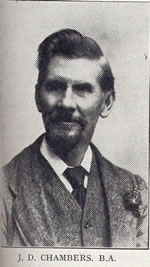 Chambers was one of the group that founded the Scottish Chess Association in 1884. He was a member of Glasgow Chess Club from 1872 onwards and was Scottish champion in 1891. He clearly did an immense amount of work to promote the game of chess throughout the UK, assisting in the formation of over 100 chess clubs. The Chess Player's Annual and Club Directory 1889 shows him with a Glasgow address and as president of many clubs including nine clubs in Scotland. Chambers was one of the group that founded the Scottish Chess Association in 1884. He was a member of Glasgow Chess Club from 1872 onwards and was Scottish champion in 1891. He clearly did an immense amount of work to promote the game of chess throughout the UK, assisting in the formation of over 100 chess clubs. The Chess Player's Annual and Club Directory 1889 shows him with a Glasgow address and as president of many clubs including nine clubs in Scotland.
The Borders and County Advertizer - 19 January 1898
Oswestry Chess Club. - In the presence of a good company, an interesting match was played at the Queens Hotel on Saturday evening, when Mr Chambers, the well known exponent of simultaneous play and ex-champion of Scotland, faced twelve members of the Oswestry Club viz., Messrs W.C.Morris, J.W.Thomsas, C.E.W.Noakes, R. Brayne, W.K.Marshall, T. Beard, R.H.Gasquoine, Sargent Bryne, P. Jones W, Roberts. H. Maclardy, and F.S.Higgs. - Mr Brayne.
Having briefly introduced Mr Chambers, play was commenced at 6.15 and continued until nearly 10.30, All the Oswestry players made a good fight but by 10 O'clock the majority had been defeated and retired from the contest. Eventually only Mr Marshell, (who had played the Sicilian defence), and Mr Noake, (who relied on the Petroff defence) survived and both these gentlemen managed to win their games, amidst applause.
The result was therefore was that Mr Chambers lost two and won ten games. - Dr O`Conor, on behalf of the club, thanked Mr Chambers for coming to them, and Mr Chambers in a humorous speech responded and congratulated the Club on being able to find twelve players of such strength. He had great experience in the opening of clubs, having formed and organised over a hundred clubs throughout the country. He considered the Oswestry players exceedingly strong on the openings of the games. - Great credit is due to Mr Higgs, the secretary, for organising such a successful match. The Club is looking forward to a visit from Mr J.H. Blackburn, the celebrated English blindfold player, early next month. |
J.H.Blackburne
- 1841 - 1924
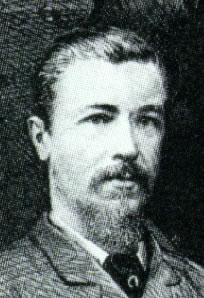
British Chess Champion Joseph
Henry Blackburne born in Manchester was one of the most successful
tournament players of the 19th century. So formidable was he that on
the continent he acquired the nickname the black death. As a professional
chess player he made hundreds of visits to chess clubs up and down the
country to promote chess with his simultaneous, often blindfold, displays.
In 1898 visitors to
Oswestry Chess Club, which had been formed nine years previously
in 1889, were charged one shilling to witness or take part in one of
his exhibitions. He won twelve and lost one in his thirteen board simultaneous
display.
Oswestry is a market town straddling the England / Wales border. Oswestry
Chess Club competed with neighbouring clubs in Ruabon, Wrexham,
and Ellesmere at the time. However in 1969 an Oswestry team entered
the Shropshire league becoming champions in 1978. |
Shropshire
County Chess Team.
The Midland Counties Chess Association, (MCCU)
was formed in 1897, following the Southern Counties (SCCU)
1892, but before the Northern Counties
(NCCU) in 1899. Thus by the end of the 19th century there was structured
county chess competition throughout England.
Shropshire were one of the founder members of the MCCU (or Association
as it was originally called). The other founders were Leicestershire,
Derbyshire, Northamptonshire, Oxfordshire, Warwickshire, Herefordshire,
Worcestershire and Staffordshire.
Shropshire were certainly playing in the MCCA in its early years and
were initially grouped with Leicestershire & Staffordshire, but
in 1913/14 the groups were changed. Leicestershire found themselves
grouped with Worcestershire & Oxfordshire, but the Leicestershire
history does not make it clear who was in the other group.
I have an extract from the BCF Year Book of 1951/2 in which the county
champions up to that year are listed. Shropshire are shown as
winners in 1915! Julie Johnson
Director MCCU
Wrexham and Denbighshire Advertiser and Cheshire Shropshire and North Wales Register
COUNTY CHESS MATCH. DENBIGH V. SALOP - 30th June 1900
The first match, which will probably become an annual fixture, was played between these counties at the Cross Foxes Hotel, Gobowen, on Saturday, and resulted in a victory for Shropshire by seven games to five, after a hard fought fight. The veteran Locke Holt, won his game against the holder of the Shropshire Challenge Cup, Mr Groom. Mr George Saint, junior, succeeded in making a draw with his old opponent, Mr J. E. Parry. Everything passed off without a hitch, and Mr and Mrs David Pryce, the host and hostess of the Cross Foxes, made their guests very comfortable. Mr C. G. Caldecott took a snap-shot of the Denbighshire team. Denbighshire played white on the odd numbered board.
Shropshire were able to draw players from Shrewsbury, Wellington, Dorley, Ellesmere, and Oswestry.
Ruabon and Wrexham only represented Denbighshire, so that the result is highly satisfactory.
DENBIGHSHIRE 5 SHROPSHIRE 7
George Saint, jnr 1/2 J. E. Parry 1/2
Locke Holt 1 E. Groom 0
George Whitehouse. 0 G. H. Locke 1
Dr. G. F. Jones 1 T. H. Chetwynd 0
J. Campbell Douglas 1 W.H.Greenhalgh. 0
W.A.Hughes. 0 E.T.Basset 1
H. Coplestone 0 C. Groom 1
R. P. Jones 1/2 F. W.Forrest .1/2
C. G. Caldecott 0 J. Groom 1
D. Ll. Davies 1 J. T. Eaches.0
Charles Simpson 0 W. A. Jones 1
J. Pinder 0 D. Matthias 1
|
The following newspaper report is one of many interesting
historical items on Bill Evans' Oswestry Chess Website
|
Border Counties Advertizer
22 May 1901
Chess: Denbighshire v Shropshire
This annual match was played at the Wynnstay Hotel, Oswestry on
Saturday and resulted in a victory for Denbighshire by six games
to four. We believe this is the first occasion on which gallant
little Wales has ever beaten England in a county match. The majority
of the games were very well contested. Subjoined is the full score.
Denbighshire - Shropshire
George Saint 0 J.E.Parry 1
L. Holt (Wrexham) 1 G.A.Lock. 0
Dr. Jones 1 A.T.Bassett 0
J.Campbell Douglas 1/2 Ernest Groom I/2
G.Whitehouse (Wx) 1 W.E.Morris 0
W.A. Hughes 0 W.H.Greenhalgh 1
Alfred Shaw 1/2 C.Groom 1/2
P.D.Rowland 0 F.W.Forest 1
Charles S.Medway 1 J.W.Thomas (Osw) O
Charles Simpson 1 Alf Jones 0 |
|
| Although
Shropshire lost this match, the text implies that this was unusual at
the time! However the Shropshire wins in 1915 season were to be the
last before a quite extraordinary barren spell for the county team.
We would have to wait a staggering 53 years before the next victory
celebration - the historic 1969 win over Worcestershire.
Two of the players in this 1901 county team later donated trophies to
be presented to future generations of players in the area. In addition
to the Ernest Groom Trophy (see below), F.W.Forest presented the Forest Cup for the Midlands Individual
Championship - a competition which lasted certainly until the 1960's.
Sadly, like so many others, this trophy has since disappeared.
Extract from Ludlow Advertiser Friday July 13th 1934
Midland Counties Individual Championship
We are pleased to learn
that Mr F.W.Forrest (hon.treasurer of the M.C.C.U.) has provided a handsome trophy for annual competition. Mr Forrest was formerly hon.secretary of the S.C.A. and a vice-president of Shrewsbury Chess Club, He still keeps up his membership of the S.C.A. and plays when he can for Shropshire.
It is interesting that the Oswestry player, J.W.Thomas, played for Shropshire
rather than Denbighshire. |
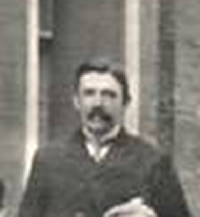 |
J.Ellis Parry - Shrewsbury Chess Club
J.E.Parry was Shropshire's strongest player at the turn of the century. In a Hereford Times article 11/08/1948 T.H.Chetwynd recalls finishing runner up to Parry in the 1899 Shropshire Individual Championship. Sadly records and presumably the trophy for the event during this period have not survived. Parry also played on top board in the county team and won the Shrewsbury Club Championship in 1899, 1901, and 1904. He competed in the British championships on several occasions including the 1906 tournament held in Shrewsbury. He later moved on playing his chess for South Manchester. |
G Bellingham v J E Parry - Worcestershire v Shropshire Dec 1898
1.e4 c5 2.Nc3 Nc6 3.Nf3 g6 4.d4 cxd4 5.Nxd4 Bg7 6.Be3 d6 7.Be2 Nf6 8.0-0 0-0 9.h3 Bd7 10.Qd2 a6 11.Rad1 Qc7 12.f4 Rad8 13.Qe1 Nxd4 14.Bxd4 Bc6 15.Bf3 e5 16.Be3 exf4 17.Bxf4 Qb6+ 18.Rf2 Rfe8 19.Be3 Qxb2 20.Rb1 Qa3 21.Rb3 Qa5 22.Bb6 Qe5 23.Bxd8 Rxd8 24.Re2 Nd7 25.Nd5 Qg5 26.Qd2 Qe5 27.c4 Nc5 28.Rb1 Re8 29.Kh1 Ne6 30.Nb4 Nd4 31.Nxc6 bxc6 32.Ree1 Qg3 33.Qd1 Be5 34.Kg1 Qh2+ 35.Kf2 c5 36.Rh1 Qf4 37.Qd3 Qg3+ 38.Kf1 Re6 39.Rb3 Rf6 40.Ra3 g5 41.Qd1 h5 42.Rd3 g4 43.hxg4 hxg4 44.Qa4 Ne6 45.Qb3 Kg7
Adjudicated win for Black. 0-1 - Hereford Times
|
|
| |
1906
British Championships
According to a contemporary edition of
the Shrewsbury Chronicle, the 1906 British Championships were held in
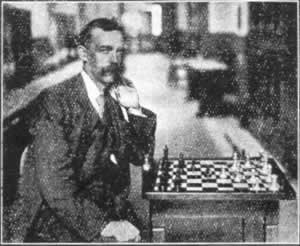
the Shrewsbury Music Hall. The event was won by Henry
Atkins, (pictured right) thus claiming the second of his nine British Championship
titles. |
 |
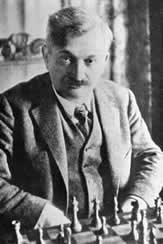
Dr Emanuel Lasker Exhibition
Extract from Shrewsbury Chronicle - Friday March 27, 1908
Dr Emanuel Lasker, the celebrated chess master, visited Shrewsbury on Saturday last, under the auspices of the Shrewsbury Chess Club, and gave an exhibition of his skill at the County Cafe. The first part of the proceedings was devoted to a lecture of a highly interesting character, in which the doctor dealt with the royal game and the lessons to be derived from it. . |
Midlands Champions
Extract from Wellington Journal 15/10/1915
Shrewsbury Chess Club.- The annual general meeting was held at the club-room, College Hill, on Oct 7. The Secretary reported that owing to the war the membership was reduced, - but that the season had been generally a successful one. The Shrewsbury club had won the Shropshire trophy, and members of the club had also materially helped Shropshire to win the championship of the Midlands for the first time in its history.
|
| The
Shrewsbury Chess Club Challenge Trophy - 1895 - 1949
This elegant silver trophy, a king on a plinth bearing shields with
the names of the winners, dates from the 1895-96 season when the victor
was R L Bartlett. There is no indication of who donated the trophy or
if it was acquired by some other means. Although one more shield could
have been added after that for the last recorded winner, in 1948-49,
it was not and so a space remains on the third layer down of the plinth.
Mr F Smart won the most with seven titles. I have no idea why there
was no winner recorded in some years. The D E McNab who won twice also
won the Shropshire Championship in the two years immediately before
the War. He came back in 1945 with the rank of Lieutenant Colonel and
then won the County Championship in the two years immediately after
the war. Sadly, he seems to have lost interest by the end of the forties
but he became well known in local golfing circles – his photograph
hangs in the gallery of former captains at Shrewsbury Golf Club at Condover
– a golfing distinction shared by Dr Gemmell – the only
surviving “name” on our ancient trophy. D
Everington
The full list of winners is: - |
1896 R L Bartlett
1897 C W Attfield
1898 John Bell
1899 J Parry, S Ralphs, J Turner
1900 George F Luff
1901 J Parry
1902 G H Lock
1903 George F Luff
1904 J E Parry
1905 no shield
1906 D Scanlan
1907 G H Lock
1908 no shield
1909 F Smart
1910 G H Lock
1911 F Smart
1912 no shield
1913 G H Lock |
1914 R L W Cooper
1915 F Smart
1916 F Smart
1917 Rev. Benson
1918 no shield
1919 no shield
1920 F Smart
1921 no shield
1922 Dr S F Smith
1923 F Smart
1924 W E Jones
1925 W D Tibbits
1926 D E McNab
1927 F Smart
1928 J Mallinson
1929 Rev.A Clover
1930 J W Henn
1931 D E McNab |
1932 no shield
1933 no shield
1934 no shield
1935 no shield
1936 D Harris
1937 J Ferrie
1938 no shield
1939 C A Bevan
1940 no shield
1941 N A Perkins
1942 Col. C Stuart-Prince
1943 J Ferrie I H Lewis
1944 Col. C Stuart-Prince
1945 Col. C Stuart-Prince
1946 C A Bevan
1947 H T Lobbenberg
1948 Dr H D Gemmell
1949 A Brace |
